
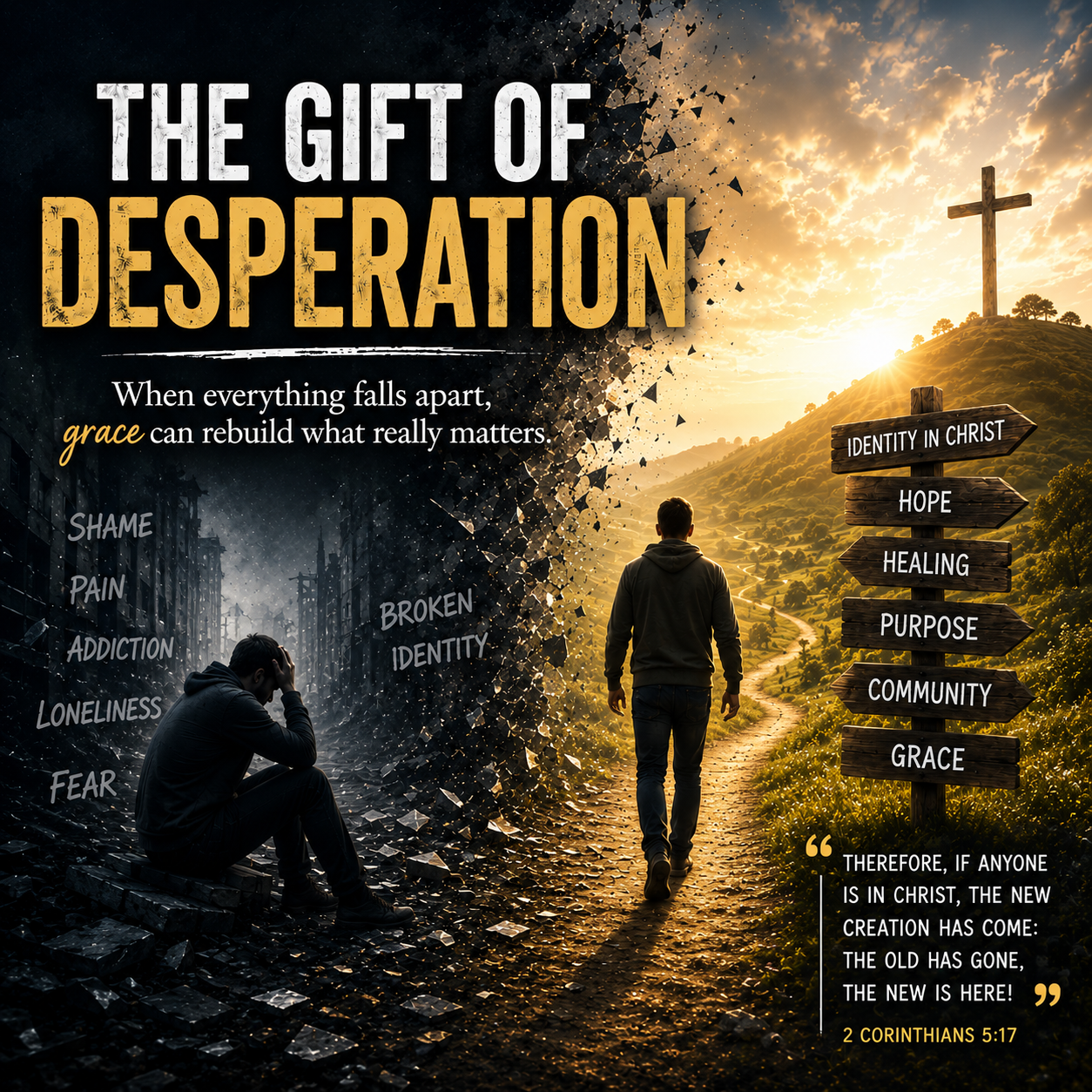
It’s a strange phrase when you first hear it.
“The gift of desperation.”
Most of us would never naturally place those two words together. Desperation feels like collapse, pressure, fear, exhaustion, or the sense that life is slipping beyond our control. A gift is supposed to be something welcomed.
And yet, in recovery spaces especially, the phrase keeps reappearing because many people eventually realise that desperation was not the moment that destroyed them — it was the moment they finally stopped pretending.
Not everyone responds to desperation in the same way. Some harden. Some retreat further into darkness. Some double down on the very patterns that are destroying them. But for others, desperation becomes a pressure point where illusion can no longer comfortably survive.
Modern psychology increasingly recognises that crisis and identity disruption can become moments of developmental transition. When old coping structures collapse, people are often forced into deeper questions of meaning, identity, belonging, and purpose.
In addiction especially, this can create what might be described as an identity collapse cycle — where shame, maladaptive coping, fractured self-understanding, and destructive behaviours begin feeding into one another until the person no longer knows who they are beyond the chaos.
In simple terms:
something has to change.
That does not automatically lead to recovery. Desperation is not recovery. It is vulnerability to direction.
At its deepest level, it becomes a crossroads:
stay in the darkness you know, or move toward a pathway you cannot yet fully see.
That is why these moments matter so much in healthcare, recovery, pastoral work, and community life. People are often far more open at these moments than they appear. Beneath the anger, defensiveness, humour, silence, or chaos, there is often a human being standing at the edge of themselves.
And what meets them there matters.
If they meet:
- shame,
- coldness,
- bureaucracy,
- superiority,
- or hopelessness,
they may retreat back into what is familiar, even if it is destroying them.
But if they meet:
- calm presence,
- dignity,
- honesty,
- consistency,
- believable hope,
- and people who see more than their addiction or diagnosis,
then desperation can become the doorway to change.
One of the dangers in modern recovery culture is that we sometimes romanticise either rock bottom or recovery identity itself. Some systems unintentionally teach people to build their entire identity around being perpetually “in recovery,” endlessly narrating pain without ever fully rebuilding life beyond it.
But recovery was never meant to become an eternal waiting room of identity maintenance.
It is meant to become a bridge toward rebuilding life again.
At some point, people need more than survival. They need:
- purpose,
- contribution,
- responsibility,
- relationships,
- laughter,
- creativity,
- service,
- ordinary life,
- and the freedom to become more than the worst chapter of their story.
That does not mean forgetting the past. It means refusing to let the past become the sole organising principle of the self.
And this is where Christian hope speaks differently.
The Gospel does not merely offer behaviour modification or endless identity as “an addict,” “an alcoholic,” or “a damaged person trying to survive.”
In Christ, identity is no longer rooted primarily in the old life, but in being made new.
That does not deny history. It redeems it.
The New Testament language is deeply hope-based:
- new creation,
- adopted,
- forgiven,
- restored,
- reconciled,
- sanctified,
- children of God.
Christian identity formation is not built around pretending the old life never happened. It is built around the belief that the old life no longer has the final word.
Too often people live either trapped in addiction identity or trapped in recovery identity. Both can keep the past sitting permanently at the centre of the self.
Jesus offers something deeper:
a new centre.
Not perfection overnight. Not denial. Not shallow positivity. But the slow rebuilding of a person around grace, truth, purpose, and relationship with God.
And practically, that matters more than people sometimes realise.
Modern psychology speaks about emotional regulation, adaptive coping strategies, resilience-building, narrative reconstruction, secure attachment, and meaning-making.
In many ways, healthy Christian identity formation touches all of these areas – not through denial or religious performance, but through learning to live from a different foundation.
Instead of constantly trying to construct an identity from trauma, addiction history, approval, achievement, or survival, the Christian begins from being loved, known, forgiven, and accepted in Christ.
That changes how people process failure, shame, anxiety, temptation, grief, and pressure.
Prayer can become emotional regulation rather than panic spiralling.
Confession can become healthy truth-telling rather than hiding.
Worship can become emotional reorientation.
Christian community can become corrective belonging.
Scripture meditation can interrupt destructive thought patterns.
Service can move people beyond isolation and self-absorption.
Hope can begin to challenge fatalism.
None of this removes the need for therapy, support, medicine, boundaries, or practical recovery work where needed. But it does mean the person is no longer trying to build a self entirely from fragments.
They are learning to live from a received identity rather than endlessly trying to manufacture one.
That changes the direction of recovery itself.
The question slowly moves from:
“How do I avoid going back?”
toward:
“What kind of person am I becoming?”
And that changes everything.
Ironically, some of the most powerful moments in recovery conversations are not the longest speeches. They are the simplest truths spoken honestly:
“I couldn’t keep living like that.”
“I was tired.”
“Someone finally treated me like a person.”
“I realised I needed help.”
Those moments stay with people because they are human.
Scripture repeatedly shows similar turning points. The prodigal son “came to himself.” Peter breaks after denial. Blind Bartimaeus refuses to stay silent. Again and again, transformation begins when people stop pretending they are self-sufficient.
Perhaps that is why desperation can become a gift — not because suffering itself is good, but because it can expose the limits of self-salvation.
And sometimes, painfully, beautifully, honestly, desperation becomes the place where a person finally becomes open not only to recovery, but to grace.
Not just a new habit.
A new heart.
Not merely surviving the old story.
Becoming part of a redeemed one.
A quiet note
If you find yourself drifting back toward familiar patterns or ways of coping, it can help to speak that through with someone you trust. You don’t have to carry that on your own.
If reading this has helped you
You may want to read:
Why We Go Back
Not Every Trigger Is a Threat
The Weight of Hopelessness
More Than the Wound
My Story
To read more of my redemption story please start here
Books
For more from me, including my published work:



Leave a comment