
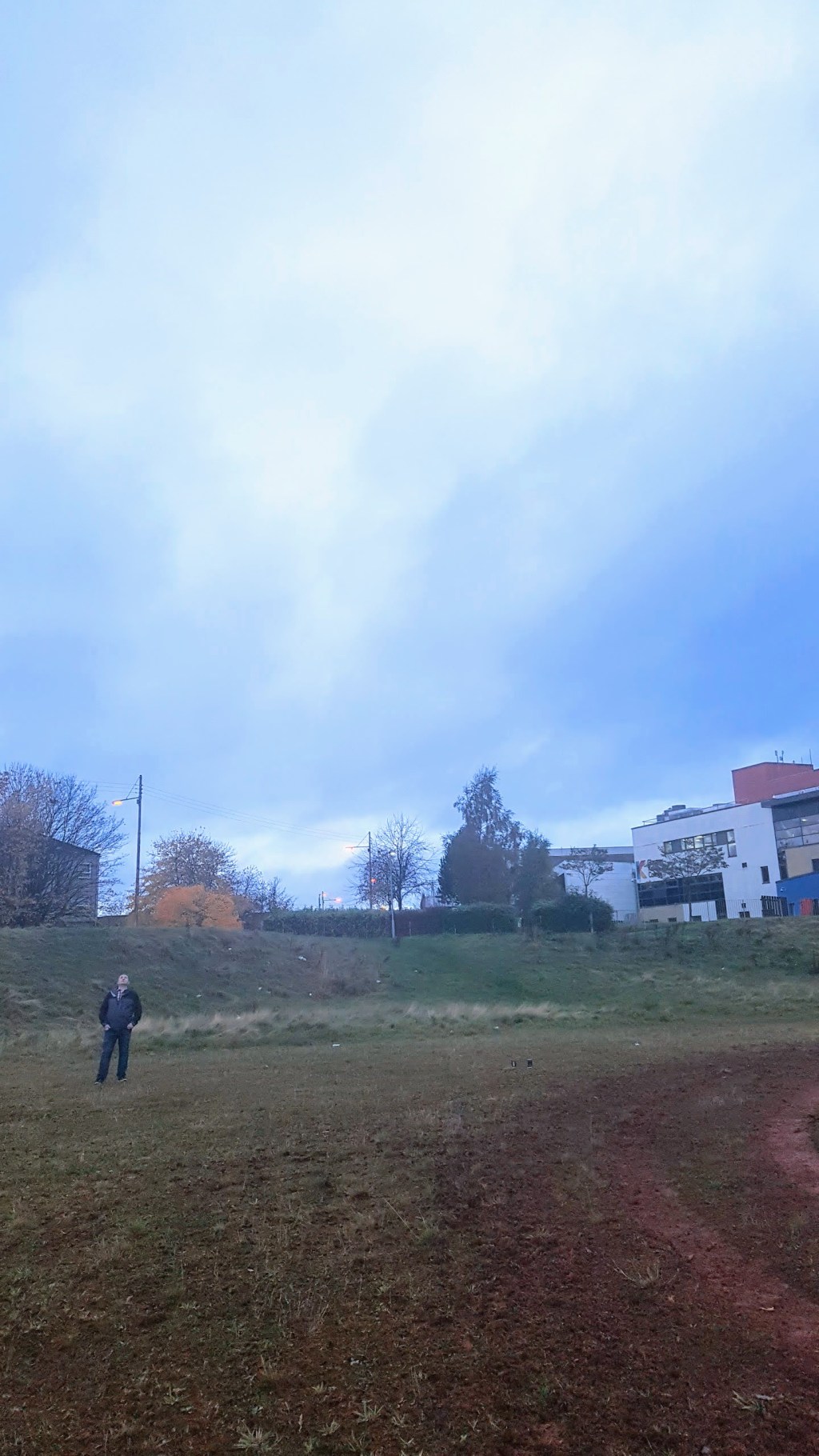
There’s an old post on this blog called Airplane Gaze.
It was written long before I ever used words like trauma or mental health.
At the time, I was just describing a moment – standing on the Westwood pitches, watching a plane pass overhead, feeling something collapse inside me. Not dramatic. Not loud. Just a quiet resignation that this was probably as far as life was going to go.
I didn’t call it trauma then.
I didn’t even call it despair.
I just knew how to stand still, look up, and carry on.
Years later, with more life behind me and more language available, I can see that moment differently. Not as weakness. Not as failure. But as a body and a soul responding to years of pressure, loss, addiction, and disappointment.
That’s often how trauma shows itself – not in one explosive event, but in the way we learn to hold ourselves in the world. Long before we have the words, the body learns what to expect, what to brace for, and how much hope feels safe to carry.
Many people who struggle with their mental health wouldn’t describe themselves as traumatised. They just know they’re tired. Or numb. Or permanently on edge. They function, they show up, they keep going – but something underneath is always braced, always waiting.
Trauma doesn’t always come from what happened once. It often comes from what happened repeatedly. Or from what never felt safe enough to name.
Growing up, a lot of us learned how to cope before we learned how to feel. We learned when to speak and when to stay quiet. How to read rooms. How to stay alert. How to disappear emotionally while still being physically present.
That kind of learning keeps you alive. But it also leaves a mark.
The difficulty is that we often judge ourselves harshly for the very strategies that once helped us survive. We call it weakness. We call it failure. We call it a lack of faith or resilience.
But much of what we’re dealing with is not moral failure.
It’s unacknowledged wounding.
The Bible has a surprising amount of patience for this kind of pain. Not the loud, catastrophic kind, but the slow erosion of hope – “a broken spirit” (Psalm 34:18), “a bruised reed” that has learned not to expect much more than survival (Isaiah 42:3).
What Scripture doesn’t tend to do is rush people.
And neither does Jesus.
When you read the Gospels closely, Jesus seems far more interested in posture than performance. He notices how people are carrying themselves. Who is bent low. Who is stuck at the edges. Who has learned to wait quietly for scraps of attention or mercy (Mark 10:46–52).
He doesn’t demand explanations.
He doesn’t force confessions.
He doesn’t hurry people into answers.
He sees.
He stays.
He asks questions that create space rather than pressure.
That matters when we talk about mental health and trauma, especially in Christian settings. Too often we try to move people too quickly towards solutions – coping strategies, declarations, fixes – without first allowing them to notice what has shaped them.
There’s a difference between being broken and being wounded.
Broken things get thrown away.
Wounded things need time, care, and safety.
A lot of people aren’t broken at all. They’re wounded – and they’ve been carrying it alone.
For some, that wound comes from addiction. For others, from violence, neglect, loss, or instability. For many, it’s a long accumulation of experiences that taught them the world wasn’t safe and that hope needed to be rationed.
That moment on the Westwood pitches wasn’t the start of my pain. It was a moment when the weight of it became visible – when I could feel, in my body, how small my world had become.
I didn’t know then that the story wasn’t finished. I didn’t know that eighteen months later I’d be stepping onto a plane for the first time. I didn’t know that recovery, faith, and a different future were already unfolding beyond my line of sight.
I just knew how to stand there and look up.
That’s why I’m careful now when talking about mental health and trauma. Because many people are standing in moments like that without knowing how to describe them. They don’t need to be told to try harder, pray louder, or move on faster.
They need to be seen.
If this resonates, you’re not weak. You’re not behind. You’re not failing at life or faith.
You’re responding to something real.
And you don’t need to resolve it today.
Sometimes the most faithful thing we can do is to notice where we learned to stand, where we learned to brace, and to believe – even tentatively – that rest might still be possible (Matthew 11:28).
Not all at once. Not neatly. But slowly, safely, and in time.
If this reflection connects with something you’re carrying, you may want to explore a few related pieces on the blog:
- Airplane Gaze – the earlier post that this reflection grows out of
- Writing from Window Seat – reflections on addiction, recovery, and learning to live differently
- Posts on faith, mental health, and community – where theology meets real life, without rushing people toward answers
You’ll find these across the blog, in your own time and at your own pace.
A quiet note
If reading this has stirred something difficult, and you feel you need to speak to someone sooner rather than later, you don’t have to carry that alone. In the UK, Samaritans are available 24 hours a day on 116 123, or at www.samaritans.org. They offer a listening ear without pressure or judgement.
Reaching out isn’t a failure — sometimes it’s simply the next small step toward staying present and safe.

 Window Seat
Leave a comment