
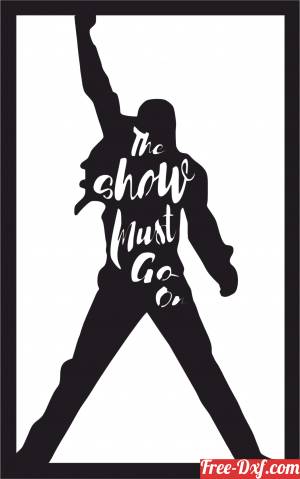
Freddie Mercury, Bohemian Rhapsody and the Death of the compliant self
by Stuart Patterson
“I lost my family when Freddie died.” — Mary Austin
“Freddie was a person of great extremes… he reinvented himself entirely.” — Brian May
“I’m not going to explain it. It’s one of those songs that speaks for itself… you can make of
it what you will.” — Freddie Mercury
INTRODUCTION
Some songs don’t just age well; they refuse to die. Queen’s Bohemian Rhapsody, released in 1975, is one of them — a six-minute act of war against every expectation placed on the man born Farrokh Bulsara.
For fifty years, listeners, critics, theologians, psychologists, and fans have chased its meaning, while Freddie Mercury spent the rest of his life refusing to give them one.
That refusal wasn’t mystique. It was mercy.
This is not a song to be “decoded” so much as a moment to be understood — a dramatic threshold between the compliant son shaped by cultural duty and the self-invented persona he would become.
Bohemian Rhapsody is not symbolic confession, nor playful nonsense, nor
camp opera for its own sake. It is a ritual execution of identity: the moment Farrokh dies and Freddie is born.
This reading emerges when psychology, music theory, theology, and Mercury’s biographical context are allowed to speak together. Beneath the absurdity and grandeur lies a single, coherent truth: the boy Farrokh dies in this song, and Freddie walks out alive.
Opposing Interpretations: Why the Usual Readings Fall Short
Before turning to the argument advanced in this essay, it is worth acknowledging the major interpretations that have dominated popular and academic readings of Bohemian Rhapsody for nearly fifty years. Each offers something helpful, yet none ultimately accounts for the coherence of the song when examined through Mercury’s biography, the lyrical architecture, or the musical structure.
1. “It’s Just Nonsense” — Mercury’s Own Evasion
Freddie often dismissed the song as “random rhyming nonsense” or “mock opera.” This view persists because it appears to come from the author himself.
But Mercury’s evasions are best understood as strategic rather than factual: a way of maintaining privacy, deflecting intrusive press, and—most crucially—shielding his parents from the autobiographical implications of the song.
His public denial tells us more about his protective instincts than about the text itself.
2. The Literal-Murder Interpretation
Some listeners have insisted on reading the song as a narrative about a man who kills someone and spirals into guilt. This interpretation cannot sustain itself against the operatic middle section, which abandons narrative realism entirely, nor against Mercury’s biography. There is no evidence he intended to confess to a literal crime. The murder is symbolic.
3. The Existential-Nihilist Reading
Another common view treats the song as expressing cosmic meaninglessness, arguing that the outro (“nothing really matters”) reflects despair. But the musical shift into a new, stable key contradicts this reading, as does Mercury’s behaviour in the decade that followed. The line is not nihilism; it is detachment — the voice of a man breaking free from the expectations that once controlled him.
4. The Sexuality-Confession Interpretation
Some scholars have suggested the murder represents Mercury “killing” the heterosexual façade and embracing his sexuality. This reading has value, particularly given Mercury’s early relationships with men in London. Yet it reduces the song to a sexual confession and overlooks the far larger cultural, religious, and familial structures shaping Mercury’s life as a young Parsi Zoroastrian immigrant.
5. The Opera-Parody Reading
A popular academic view argues that the entire piece is simply a parody of 19th-century Italian opera. While this explains the aesthetic flamboyance, it cannot explain the emotional weight of the ballad, the theological charge of “Bismillah!”, the courtroom structure of the middle section, or the deeply personal resonance the song maintained for Mercury throughout his life.
Why a New Interpretation Is Needed
All these interpretations illuminate part of the picture, but none accounts for the emotional, biographical and musical coherence of the whole.
What emerges instead — and what this essay argues — is that Bohemian Rhapsody is best understood as an act of identity execution: the symbolic killing of Farrokh Bulsara and the emergence of Freddie Mercury.
And it is precisely this reading that brings the song’s final line, his lifelong silence, and the musical structure into alignment.
Part I — The Execution
1975: The Execution of Farrokh
Is this the real life? Is this just fantasy?
Caught in a landslide, no escape from reality…
Open your eyes, look up to the skies and see…
The opening lines have long been treated as existential panic. But Mercury doesn’t sing them like a man in crisis — he sings them like a man mocking something. The tone is soft, over-enunciated, almost childish. It is ventriloquism.
He is holding up the old mask — the dutiful Zoroastrian boy, respectful, well-behaved, expected to follow a clear path — and mimicking it one last time.
I’m just a poor boy, I need no sympathy…
Sung like a parody of humility, it is the final performance of the compliant self. Then sudden harmonic tension arrives — and the mask falls.
Mama, just killed a man.
Put a gun against his head, pulled my trigger, now he’s dead.
This is not melodrama; it is declaration. The “man” is Farrokh Bulsara — the version of himself shaped by family expectation, cultural respectability, religious duty, and heterosexual assumption. Freddie has executed him. There is no regret in the delivery, no apology buried in the melody. This is not a plea for absolution. It is a status update.
Life had just begun,
But now I’ve gone and thrown it all away…
Thrown away from whose perspective? His parents’. His community’s. The world he inherited.
Too late, my time has come,
Sends shivers down my spine, body’s aching all the time…
This ache isn’t about guilt — it’s the bodily cost of internal rupture. Every major psychological transformation has a somatic signature. The tremor is the body reacting to the death of an identity that had once held everything in place.[1]
Goodbye everybody — I’ve got to go…
Gotta leave you all behind and face the truth…
He isn’t running from a crime — he is walking away from the life others scripted for him. It is not escape; it is departure.
By the end of the ballad, the compliant son is dead. The trial now begins.
Part II — The Trial
The Trial of Voices: Operatic Schism and Ancestral Authority
I see a little silhouetto of a man…
The operatic section is often dismissed as camp excess, a theatrical detour before the rock riff. But it is the psychological and spiritual core of the entire song. The silhouetto is not a stranger. It is the outline of the self Freddie has just killed — the faint shape of Farrokh flickering at the edge of consciousness like an afterimage.
Scaramouche, Scaramouche, will you do the fandango?
The Scaramouche is a stock character from commedia dell’arte: a coward hiding behind masks, blustering with false bravado. He is perfect as a representation of the old self: anxious, compliant, and always performing. The fandango — frantic, circular, breathless — is the dance of a man trying to escape himself.[2]
This is not nonsense. It is the mind in fracture.
Thunderbolt and lightning — very, very frightening me…
Transformation is violent. Church fathers, modern psychologists, and every tradition of spiritual autobiography agree on this: rebirth feels like storm. The old self does not die peacefully; it convulses.
Then the chorus of archetypes enters:
Galileo… Galileo…
Galileo Figaro — magnifico…
These names are not random shouts. They form a symbolic constellation that mirrors Mercury’s interior world:
- Galileo, the heretic condemned by religious authority
- Figaro, the servant who outwits his masters
- Magnifico, grandeur, self-made greatness
These are the ingredients of Mercury’s metamorphosis — rebellion, ingenuity, self-exaltation.
And then, the opera becomes a courtroom.
He’s just a poor boy from a poor family…
Spare him his life from this monstrosity…
Here the voices speak about him, not as him. They represent the imagined chorus of family, culture, religious tradition, and communal expectations pleading for the old self to be spared. This is what every immigrant son knows: your life is never only your own.
Then comes the line that turns the whole song:
“Bismillah! We will not let you go!”
This is not decorative. “Bismillah” — In the name of God — is the invocation of divine authority. It is the voice of the old world, the religious world, the ancestral world. The place he came from. The place that named him Farrokh.[3]
“We will not let you go” is not metaphorical pressure — it is the full weight of cultural and spiritual inheritance refusing to release him.
But another chorus rises:
“Let him go!”
These are the forces of individuation, secular modernity, self-invention, artistic freedom — the new gods Freddie has chosen. The tug-of-war lasts six bars, neither side giving way. This is the true heart of the song: identity, family, and faith in open conflict.
Then the verdict is delivered with operatic finality:
“Beelzebub has a devil put aside for me — for ME!”
Listeners often assume this is fear. It isn’t. It is mockery.
The old cosmology — heaven, hell, judgment, reward — is being ridiculed. The line is theatrical defiance: even your devil has no claim on me now.
The gong crashes. The trial ends.
The old world has lost.
Part III — The Confrontation
The Hard-Rock Confrontation: Revolt Against the Old World
When the operatic trial collapses, the song erupts.
So you think you can stone me and spit in my eye?
So you think you can love me and leave me to die?
This is not directed at a lover. The imagery is biblical — spitting, stoning, abandonment — the vocabulary of judgment. This is Freddie turning on every authority that once claimed the right to define him: family expectation, religious condemnation, cultural propriety, even the God invoked moments earlier.
So you think you can love me and leave me to die?
This is the cry of a man naming the conditional love he grew up under — affection that depended on compliance. It is the rebellion of a son refusing to be rescued only on someone else’s terms.
Oh, baby — can’t do this to me, baby!
The term “baby” here is not romantic tenderness. It is almost mocking — a dismissal of the moral structures he has outgrown.
Just gotta get out — just gotta get right outta here!
This is escape velocity. Everything that once bound him — the former self, the inherited faith, the family’s hopes — explodes behind him. The guitars hit like demolition charges. The drums drive forward. The vocal no longer trembles; it roars.
The boy Farrokh has been buried. The man Freddie is fully alive.
Part IV — The Resolution
A New Tonal Centre: The Music Proves the Metamorphosis
Most interpretations fail to notice what music theorists point out clearly:
the song does not return to the key it began in.
Bohemian Rhapsody opens in E♭ major — a key associated with warmth, tradition, and stability. It ends in F major — a brighter, more declarative key — and stays there.[4]
It never goes home.
In music, returning to the original key symbolises restoration or reconciliation. Modulating to a new key and remaining there represents change — irrevocable, definitive change.
The tonal architecture reinforces the narrative:
Farrokh’s key dies; Freddie’s key takes its place.
The Sovereign Outro: Not Nihilism, but Detachment
Nothing really matters, anyone can see
Nothing really matters — nothing really matters to me…
These lines have often been read as despair. But the delivery tells another story. Gone is the trembling boy from the opening. This voice is steady, relaxed, almost serene. The difference between the first “any way the wind blows” and the last one is the difference between submission and sovereignty.
At the start, the wind blows him.
At the end, he no longer cares which way it blows.
This is not nihilism. It is emotional independence — sovereignty. He has severed the cords that once held him. Expectations no longer touch him. The self that once trembled has been executed; the self that remains is untouchable.
It is the calm after self-liberation.
What Christianity would call death and resurrection, Mercury resolves as death and sovereignty — a salvation without surrender, and a freedom that answers to no authority beyond the self.
Part V — The Mercy of Silence
Filial Silence: The Last Mercy
Across the decades, Mercury refused to explain the meaning of Bohemian Rhapsody. When asked, he would smile, shrug, or dismiss it as “mock opera.” But this refusal wasn’t coyness. It was compassion.
Had he publicly confessed the song as autobiography, it would have humiliated his devout Parsi parents within their tight-knit community. It would have been an act of rebellion that wounded people he genuinely loved.[5]
Silence allowed two versions of the truth to coexist:
- To him, the song was a personal execution ritual.
- To his parents, it could remain an extravagant piece of theatre.
It was the last gift the liberated son could give the mother who still called him Farrokh.[6]
Coda: The Silhouetto Stays Silent
On stage — especially at Live Aid — Freddie became the kind of figure Renaissance painters would have mistaken for a secular messiah: arms raised, chest bare, multitudes responding like a congregation. But behind that brilliance, the silhouette of the boy he once was never entirely disappeared. It simply stopped speaking.
Farrokh died in 1975.
Freddie lived until 1991.
And for the sake of love, the line between them was never spoken aloud.
References
Primary Sources (Lyrics, Interviews, Performances)
Mercury, F. (1975) Bohemian Rhapsody. On Queen, A Night at the Opera. London: EMI/Elektra Records.
Queen (1975) A Night at the Opera (Album liner notes). EMI/Elektra Records.
Austin, M. (1992) Interview. OK! Magazine, 17 November.
Mercury, F. (1985) Interview, Live Aid, Wembley Stadium, BBC Television, 13 July.
Mercury, F. (1986) Queen: A Magic Year. BBC Documentary.
Hutton, J. (1994) Mercury and Me. London: Bloomsbury.
May, B. (2018) Interview in Bohemian Rhapsody: The Official Book of the Movie. London: Queen Productions.
Biographical / Historical Sources
Blake, M. (2016) Is This the Real Life? The Untold Story of Queen. London: Aurum Press.
Jones, L-A. (2011) Mercury: An Intimate Biography of Freddie Mercury. London: Hodder & Stoughton.
Richardson, R. (2023) ‘Mercury’s Zanzibar Years: Zoroastrian Childhood and Colonial Identity’, Journal of African Cultural History, 12(3), pp. 47–63.
Luhrmann, T.M. (1994) The Good Parsi: The Fate of a Colonial Elite. Cambridge, MA: Harvard University Press.
Music Theory & Analysis
Bennett, D. (2020) Why Bohemian Rhapsody Works: Music Theory Analysis.
Available at: https://www.youtube.com/davidbennetttheory (Accessed: [insert date]).
Everett, W. (2000) The Foundations of Rock: From “Blue Suede Shoes” to “Suite: Judy Blue Eyes”. Oxford: Oxford University Press.
Osborn, B. (2013) ‘Understanding Rock Tonality: Modulation as Narrative’, Music Theory Spectrum, 35(1), pp. 45–68.
Psychology, Theology & Identity Theory
van der Kolk, B. (2015) The Body Keeps the Score: Brain, Mind, and Body in the Healing of Trauma. London: Penguin.
Taylor, C. (1991) The Ethics of Authenticity. Cambridge, MA: Harvard University Press.
Williams, R. (2014) Being Human: Bodies, Minds, Persons. London: SPCK.
Nicoll, A. (1963) The World of Harlequin: A Critical Study of the Commedia dell’Arte. Cambridge: Cambridge University Press.
Abdel Haleem, M.A.S. (2005) The Qur’an: A New Translation. Oxford: Oxford University Press.
Graham, E. (2017) Between a Rock and a Hard Place: Public Theology for a Post-Secular Age. London: SCM Press.
Goffman, E. (1959) The Presentation of Self in Everyday Life. New York: Doubleday.
Hall, S. (1996) ‘Cultural Identity and Diaspora’, in Hall, S. et al. (eds.) Modernity: An Introduction to Modern Societies. Oxford: Blackwell, pp. 596–634.
Bhabha, H.K. (1994) The Location of Culture. London: Routledge.
[1] Bessel van der Kolk’s work on trauma and identity change argues that psychological rupture manifests somatically; the body “remembers” and reacts when the self undergoes significant internal change.
(See: van der Kolk, B., 2015, “The Body Keeps the Score.”)
[2] The character of Scaramouche appears throughout 17th–18th-century commedia dell’arte as a boastful but cowardly figure who hides behind performative bravado. His presence in Mercury’s operatic sequence aligns with the motif of the “old self” performing roles for social approval.
(See: Nicoll, A., 1963, “The World of Harlequin: A Critical Study of the Commedia dell’Arte.”)
[3] “Bismillah” (Arabic: bi-smi llāh, “In the name of God”) opens every chapter of the Qur’an except one and appears widely in Islamic and Persianate devotional traditions. Its use here signals an appeal to transcendent authority and situates the operatic dialogue in a religious register.
(See: Abdel Haleem, M., 2005, “The Qur’an: A New Translation.”)
[4] Music theorist David Bennett and several independent analysts have demonstrated that Bohemian Rhapsody modulates from E♭ major to F major in its final minute. In standard tonal analysis, ending in a new key without returning to the original signifies a decisive shift of centre rather than resolution.
(See: Bennett, D., 2020, “Why Bohemian Rhapsody Works: Music Theory Analysis.”)
[5] Historical studies of East African and Indian Parsi communities note the strong importance of family honour, religious continuity, and communal reputation, which often extend across generations and diaspora networks. Mercury publicly contradicting these values would have carried social costs for his parents.
(See: Luhrmann, T.M., 1994, “The Good Parsi: The Fate of a Colonial Elite.”)
[6] Mercury consistently declined to interpret Bohemian Rhapsody in interviews, often smiling and offering playful evasions. Biographers suggest this reticence stemmed less from secrecy than from protecting those closest to him from personal or cultural embarrassment.
(See: Jones, L-A., 2011, “Mercury: An Intimate Biography.”)
If this resonated:
Much of the writing on this site explores similar territory — identity under pressure, belief tested by lived experience, and the cost of becoming someone other than who you were expected to be. You can browse related essays through the menu above.

 Window Seat
Leave a comment