
You’re going about your day, minding your own business, when the universe decides to slap you. Not metaphorically — a full, open-handed wallop that leaves you blinking at reality, wondering who changed the script.
That’s what happened to me that day.
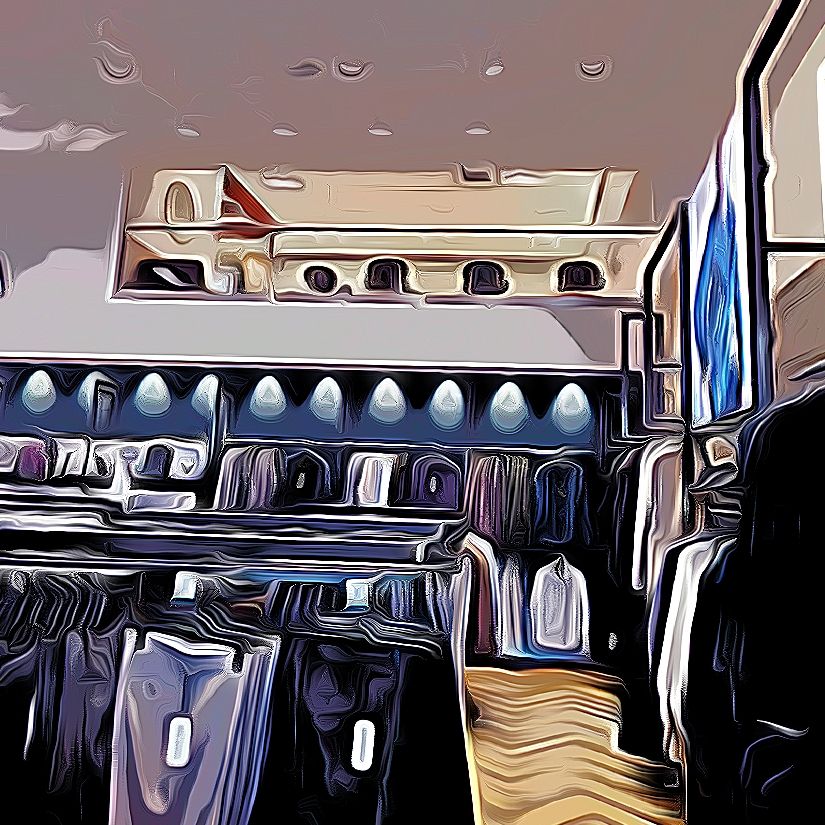
I was upstairs in Costa — the one tucked inside NEXT at Braehead — perched on the mezzanine above the menswear section. The staircase to my left, tables to my right, overlooking neat rows of suits and shirts directly below. From where I sat, latte in hand, I could see almost the whole store: the cash desk glowing under spotlights, mannequins lined like sentries, and the long aisle leading to the exit doors and escalators beyond.
Saturday: the centre alive with light and noise, music leaking from doorways, perfume clouds drifting like incense, families performing the weekly liturgy of retail salvation.
I’d earned a latte and a few minutes of peace. Or so I thought.
Then I saw him.
Mid-twenties, dark hair standing up like a question mark, navy coat zipped to the neck though the air-con was Arctic. He hovered near the shirts, not browsing so much as scanning, and in his left hand — something small and metallic. Only the top visible when the light caught it: a ring, a pin, a curved lever.
A vaguely familiar appearance — something that ignited a thought trying to explode its way from my subconscious into my conscious.
It shot me straight back to the Commando comics of my childhood — all square jaws, smoke trails and melodrama. Those covers burned the image of the grenade into my brain: a clenched fist, pin half-pulled, doom seconds away.
And now there it was, in Braehead.
The exact top of a hand grenade.
My chest tightened.
He turned the thing nervously in his pocket, glancing about.
I leaned toward the security guard at the next table — big lad, shaved head, expression halfway between suspicion and regret.
“Don’t use your radio,” I whispered.
“Eh?”
“They’ll hear you.”
“Eh?”
“Down there. Blue coat. Left hand. Looks like a grenade.”
The guard followed my gaze.
To his credit, he never laughed at me.
He looked solemnly at his half-finished drink, set it down, slowly got to his feet and walked off trying to look casual.
He failed magnificently.
My eyes tracked him as my asthmatic breathing tightened my chest.
He stepped down the stairs slowly, making his way around to the menswear.
He leaned toward another guard at the counter, hand on the man’s wrist, mouth close to his ear.
A whisper.
A stagger backwards.
The definite paling of the second guard’s face as he tried to look without looking like he was looking.
He failed magnificently too.
Other staff were already drifting closer, drawn by the magnetic pull of fear.
That’s how it started. Not with sirens — with whispers.
“He’s got something.”
“They think it’s a bomb.”
“Police are coming.”
“Snipers already here.”
Each retelling gathered weight.
Staff whispered to staff, customers caught fragments, and fear travelled faster than Wi-Fi.
The crowd kept shopping but slower now, movements cautious, like fish sensing a predator.
The man left NEXT, oblivious to the conspiracy forming behind him.
Two guards followed him.
Out through the main doors and down the escalator they went — and I followed, but from above.
Others seemed to follow me, though no one spoke.
We drifted along the upper level like anxious shadows, craning over the wooden rail to track him below.
The guards trailed him along the lower concourse, weaving through the weekend crowd.
From above, we moved in eerie synchrony, staring past the three large balcony bays that cut through the upper floor like open wells.
Each gap framed the scene below — a moving target ringed by watchers who pretended not to be watching.
Failing magnificently.
At the far end, the space opened into the central atrium: the marble circle gleaming under the skylight, the garden-furniture pop-up glowing like a stage set for disaster.
He walked straight into the middle of it.
Around me, a throng of guards gathered along the curved glass rail, trying to be invisible despite the transparency.
Failing magnificently.
Their fingers gripped the polished wood like parishioners clutching a pew.
The circular balcony seemed to tighten with every heartbeat, closing in like a hangman’s noose above the scene below.
Someone whispered,
“He’s waiting for the signal.”
Another, “He’s about to pull it.”
On the bridge near the management offices, two armed response officers crouched, scanning.
No radios, just the hum of breath and dread.
My paranoia had become mall policy.
Then he moved.
He stepped toward a woman browsing the patio sets — phone in hand, smiling, unaware.
The shout cracked through the air like thunder:
“Stop! Police! Get on your knees and remove your hands slowly from your pocket!”
Every sound died.
Deckchairs toppled.
People screamed.
The woman froze.
The man froze.
Then, trembling, he obeyed — one knee lowering to the floor, one hand steadying himself, the other emerging slowly, fingers unclenching.
The supposed “grenade” pin glinted in the light — now clearly an engagement ring, held alongside a green handkerchief with silver edging, crushed in his sweating, outstretched palm.
For a heartbeat, no one moved.
Then understanding rippled outward.
The ring.
The kneel.
The gasp.
He stayed there — one knee down, one hand on the floor, the other outstretched — ring shining, handkerchief trembling, devotion mistaken for threat.
She dropped her phone, covering her mouth.
Tears came.
Up on the bridge, one officer swore softly.
The rest of us clapped like survivors of our own stupidity.
When it was over, the mall exhaled.
Staff straightened signs.
Shoppers drifted back to their rituals.
The couple stood radiant under the skylight, haloed by love and near-disaster.
I sat back down, pulse still drumming, latte long cold.
A manager approached, pale and polite.
“Everything all right, sir?”
“Oh aye,” I said. “Nation’s safe. Coffee’s done for.”
She didn’t laugh.
Neither would I have.
You think you’re the watchman, the sensible one.
But sometimes you’re just the echo that starts the panic.
Still — she said yes.
And I got a story.
Possibly a sermon.
Definitely a lifetime ban from NEXT.
Contextual Note
The Braehead Ring – The Day I Nearly Saved the World is a darkly comic meditation on perception, fear, and grace in the ordinary. Written in a confessional first-person voice, it portrays an anxious observer who mistakes the top of an engagement ring for a grenade and, through whispered contagion, creates a collective hallucination. The story draws on the real geography of Braehead Shopping Centre — its mezzanines, balconies, and open wells — turning retail architecture into moral theatre.
Theologically, it becomes a parable of misread revelation: the crowd mistaking love for threat, devotion for danger. Its humour exposes how easily faith and fear can share a vocabulary, echoing Mark 3:21–22, where even Jesus’ own family and the scribes misread divine compassion as madness or menace. The episode recalls wider biblical moments of mistaken perception — the storm-stilled disciples who “were greatly afraid and said to one another, ‘Who can this be?’” (Mark 4:41), or the Emmaus travellers whose eyes “were restrained, so that they did not know Him” (Luke 24:16). Each story reveals the same pattern: grace appearing in forms our fear cannot recognise.
As N. T. Wright notes, “When the real Jesus comes into view, people often prefer their own idea of him; revelation threatens our control.” The ring in this story becomes a comic sacrament — a symbol of grace revealed through misunderstanding. In this sense, the piece belongs to a wider theology of creative practice, where laughter and revelation share the same pulse, and redemption often arrives disguised as farce.
Thanks for reading this piece from my Theology Through Creative Practice portfolio. I’m exploring where ordinary moments become parables — sometimes of fear, sometimes of grace, sometimes of our own daftness. If you’d like to follow the wider project, you can browse more of my work across the site.
If you liked this…
- Other Glasgow-based creative pieces — stories where the familiar becomes strange, funny, or revealing.
- Theology Through Creative Practice reflections — exploring how stories, place, and faith speak to one another.
- My upcoming essay on Bohemian Rhapsody — a deep dive into music, identity, and theology.
- Short stories from my PhD portfolio — fiction rooted in lived experience, humour, fear, and hope.
- Window Seat memoir posts — reflections, drafts, and behind-the-scenes material from the journey that started it all.

 Window Seat
Leave a comment