
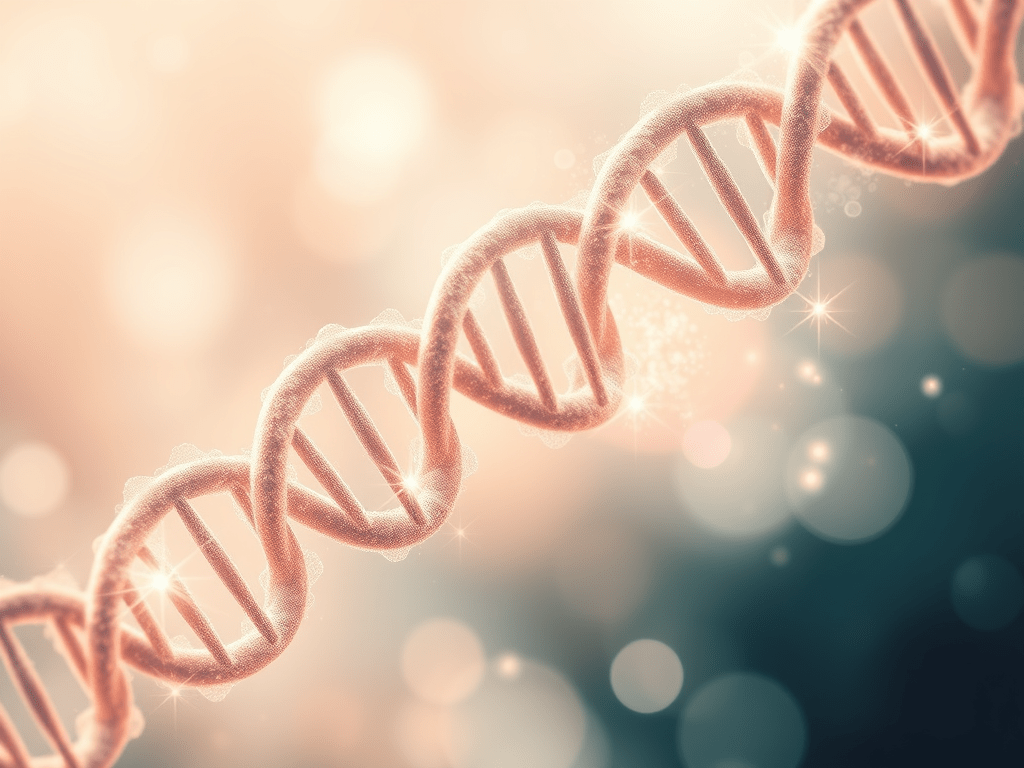
Christ as the Living Design for a Broken Creation
If science can recognise a flaw in the human genome, it’s only because somewhere there exists a perfect pattern to compare it with. Every mutation assumes a design that came first. That truth hums quietly beneath every microscope and research paper: we only call something broken because, deep down, we remember what wholeness is.
Faith names that wholeness not as an abstract formula but as a person.
The straight line behind every crooked one, the uncorrupted code within all corruption — that line is Christ.
“The Word became flesh and made His dwelling among us.”
(John 1:14)
In Him, the image of God walks once more among its copies. The incarnation is not divine curiosity about human life; it is the Author stepping into the text to rewrite it from within.
This reflection continues the journey begun in In His Mould – Formed by Grace, Shaped by Christ, exploring how the person of Christ becomes the mould through which divine image is reformed in human life.
Creation began with a voice. The same Word that spoke galaxies into being became syllables of skin and blood, born into the very system He once called good. Jesus is the living genome of grace — the perfect design moving through a world of mistranslations, realigning it line by line, life by life.
The Original Code
Genesis describes humanity as created in the image of God. It’s a phrase that has carried theologians, artists, and scientists into centuries of wonder. What does it mean? Not that we share God’s biology, but that we share His capacity — for thought, love, creativity, and communion. We were made to mirror His moral and relational character, to hold creation’s stewardship as its living reflection.
Then God said, “Let Us make man in Our image, according to Our likeness; let them have dominion over the fish of the sea, over the birds of the air, and over the cattle, over all the earth and over every creeping thing that creeps on the earth.”
Genesis 1:26 (NKJV)Human beings were never meant to be gods, but images of God — like windows through which divine light could shine into the world. Yet the moment Adam and Eve grasped at autonomy, the window cracked. Self-will replaced self-giving, and the image fractured.
The Bible calls it sin; science might call it corruption in the data. The likeness remains, but the code runs with errors. Creation still bears its Maker’s mark, but it no longer functions as intended.
We still build, love, dream, and create — but often in ways that serve self rather than glory. The image is there, but blurred; the software is brilliant, but compromised.
he same distortion — beauty turned inward — is mirrored in my memoir Window Seat: A Life Rewritten, where grace rewrites a broken life back toward purpose.
The Divine Intervention
Into that damaged system, God didn’t send a command or a manual; He came Himself.
The Incarnation is the ultimate act of divine repair.
“The Holy Spirit will come upon you, and the power of the Most High will overshadow you.”
(Luke 1:35)
In the hidden quiet of Mary’s womb, eternity touched matter. The divine Word entered a human cell and wrote a new line of history. No human father, yet fully human child — a life both ancient and new. Jesus’ humanity was no costume. He bore our physical DNA, our breath, our blood, yet without the hereditary fault of sin.
If Adam represented humanity’s corrupted genome, Christ embodied its restoration. Every act of Jesus was the code rewritten in real time — mercy restoring cruelty, truth cleansing deceit, healing undoing decay.
Grace as Re-Sequencing
If sin corrupts, grace rewrites. It’s not a legal pardon; it’s a living process of restoration. The Holy Spirit is the divine restorer — the One who moves through the pages of a damaged manuscript and traces the faded ink of God’s image until it becomes legible again.
Grace does not discard what’s damaged; it renews what’s valuable. It’s the difference between scrapping a masterpiece and cleaning the soot from its surface.
This renewing process echoes through my reflections in In His Mould – Walking It Out, where the Spirit’s work is seen not as replacement but as restoration.
In my own life and ministry, I’ve seen grace work this way — not as instant perfection, but patient editing. A man broken by addiction learns to hope again. A woman haunted by shame finds peace where fear once lived. God doesn’t write us off; He writes Himself in.
“I will give you a new heart and put a new spirit within you.”
(Ezekiel 36:26)
Holiness, then, is not cold purity but restored function. Grace doesn’t make us less human — it makes us fully human.
Faith and Order — Two Languages of Wonder
Every scientist begins with a form of faith — the belief that truth exists, that order can be found, that chaos can be understood. Without that trust, no experiment would begin.
As physicist-theologian John Polkinghorne once observed, science and faith are not opponents but partners in seeking coherent truth — a conviction that runs through this reflection.
Theology starts in the same conviction but completes the sentence: order exists because there is a Mind behind it.
For another example of how culture and theology meet in unexpected harmony, read Bohemian Rhapsody: The Theology of a Song — a creative reflection on redemption, hidden in art. That will appear soon on this blog.
Science and faith are not rivals but relatives. They share the same grammar of wonder. Science studies the structure; faith seeks the Source. Both are confessions that reality is not random but relational.
The Christian claim goes further: the same Logos who structured the laws of physics authored the laws of love. To follow Christ is to discover that the deepest logic of the universe is personal — not merely mathematical, but incarnate.
The Repair Made Visible
On the cross, the perfect code met the full consequence of corruption.
The Author entered the worst sentence in the story and rewrote it from the inside out.
“He who knew no sin became sin for us, that we might become the righteousness of God.”
(2 Corinthians 5:21)
The crucifixion wasn’t cosmic theatre — it was surgery. Love went to the root of the infection and absorbed it. When Christ rose, the repaired pattern emerged: humanity restored, death defanged, corruption reversed.
“What is sown perishable is raised imperishable.”
(1 Corinthians 15:42)
This vision of resurrection aligns closely with N.T. Wright’s insight that “the resurrection is not about escape from the world but the renewal of creation.”
(Hear more from N.T. Wright, Resurrection and the Renewal of Creation)
The resurrection is the great unveiling — proof that the genome of grace works. Christ is the prototype of a redeemed humanity, the first cell of a new creation.
Participation in the Process
The same Spirit who conceived Christ in Mary now forms Christ within us. Redemption is not a single event but an ongoing transformation — a replication of the restored pattern in human hearts.
Grace works quietly, like DNA replicating beneath the surface, unseen yet determining everything.
Each act of forgiveness is a line rewritten.
Each surrender to truth is a mutation reversed.
Each moment of love is the original design flickering back into view.
Faith is cooperation with divine editing. God doesn’t overwrite the unwilling; He invites consent. “Behold, I make all things new” isn’t a demand but a promise — and a partnership.
The Final Sequence
All of creation groans for that final correction — the day when the repair will be complete.
“Behold, I am making all things new.”
(Revelation 21:5)
The same voice that spoke the universe into existence will speak again, and this time the whole creation will answer in tune. The genome of grace will run through everything — no corruption, no decay, no death.
A Personal Reflection
I’ve seen glimpses of that new creation in unexpected places — not in laboratories or lecture halls, but in church halls, rehab centres, and quiet conversations after prayer. I’ve seen men who once believed they were beyond redemption find themselves rewritten by mercy. I’ve seen women scarred by loss discover new joy that seems to come from somewhere else entirely.
These stories are living proofs of the genome of grace at work — real people becoming what they were always meant to be. The old patterns still whisper, but the new one sings louder.
“He who began a good work in you will carry it on to completion.”
(Philippians 1:6)
We are not accidents of chemistry or victims of faulty wiring. We are manuscripts under restoration. The same God who shaped the stars is still tracing His signature through the dust of our lives.
The Word became flesh – and He is still rewriting us.
Explore more reflections and creative theology at stuartpatterson.blog, or find my published works — including Window Seat and the In His Mould series — on Amazon.
For Readers Who Want to Go Deeper
For those who’d like to explore the full academic version — complete with theological references, footnotes, and detailed analysis — you can download the essay here:
👉 Download “The Genome of Grace – Full Theology Essay (PDF)”
This expanded version traces the same idea through theology and science — how Christ becomes the living design for restored humanity.
Closing Prayer
Lord Jesus,
You are the Word that became flesh,
the perfect design walking among our flaws,
the repair written into our ruin.
Where the pattern of my life is broken,
trace again the image of Your love.
Where the code has been corrupted by fear or pride,
breathe Your Spirit through it until grace takes shape.
Teach me to live as part of Your restoration —
to forgive where bitterness has taken root,
to create beauty where despair has left blanks,
to reflect Your light in every line of my story.
Let Your patience be my process,
Your mercy my editing hand,
and Your resurrection my proof that nothing
is too far gone to be rewritten by grace.
Amen.
If this reflection spoke to you, you can find more of my writing — stories, devotionals, and reflections on grace — on my Amazon author page. Each book carries the same heartbeat: hope, faith, and the God who still rewrites lives.

 Window Seat
Leave a comment