
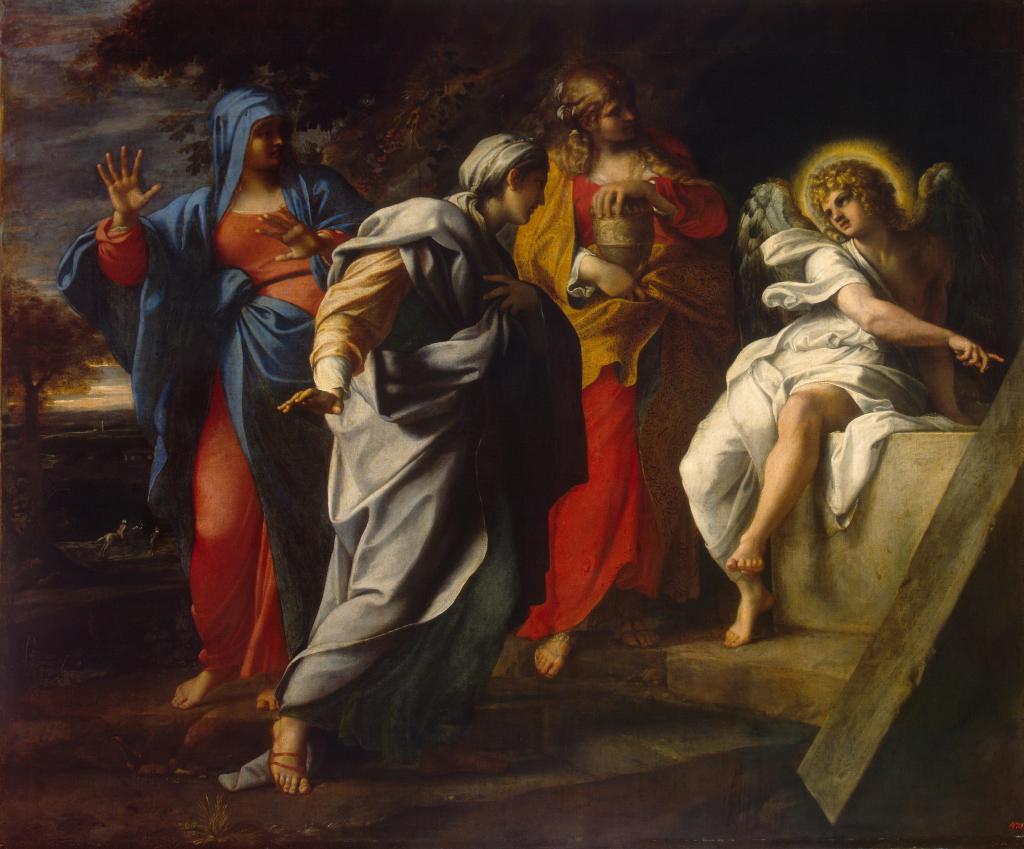
Why the Empty Tomb Is Not Silence—but Declaration
On The Third Day
We’ve walked through this weekend step by step.
On Friday, we stood at the cross—where everything changed, not by taking, but by giving.
On Saturday, we sat in the silence—where nothing seemed to move, and everything felt finished.
And now—Sunday.
The stone is no longer where it was.
The silence does not hold.
And what looked like the end is about to speak.
When the Silence Breaks
For two days, everything held.
The cross stood.
The body was buried.
The stone was sealed.
And the world carried on as if the story had ended.
Silent Saturday left us there—
waiting,
uncertain,
sitting in the space between what had happened
and what had not yet been seen.
But Sunday does not continue that silence.
It breaks it.
Very early in the morning, they go to the tomb.
Not expecting resurrection.
Not looking for victory.
Just to finish what death had started.
“But on the first day of the week, very early in the morning… they came to the tomb bringing the spices which they had prepared.” (Luke 24:1, NKJV)
The Wrong Question
And what they find is not what they expected.
The stone is moved.
The body is gone.
And immediately, the question begins:
Where is He?
But that question misses the point.
Because the stone was never moved so Jesus could get out.
He was not trapped inside.
The stone is moved so we can see.
When Death Had to Speak
See what?
That death has already lost.
We often speak about the resurrection as something God declares.
And it is.
But there is another way to see it.
The empty tomb is not just God speaking.
It is death being made to answer.
To admit—publicly, unmistakably—that it no longer has the final word.
“Why do you seek the living among the dead? He is not here, but is risen!” (Luke 24:5–6, NKJV)
That is not just information.
That is exposure.
On Friday, it looked like death had won.
On Saturday, it felt like death had the final word.
On Sunday, death is made to give it back.
Not gradually.
Not symbolically.
Completely.
Not Escape—Overthrow
As N. T. Wright argues in The Resurrection of the Son of God (2003), the resurrection is not a private spiritual event but a public, historical claim about what God has done in the world—overturning what appeared to be the finality of death.
This is not simply a return to life.
It is not Jesus escaping death.
It is death being undone from the inside.
This echoes the early church’s understanding. Athanasius of Alexandria writes in On the Incarnation that Christ entered death in order to destroy it, so that death itself might be brought to nothing through His resurrection.
And as the apostle Paul later puts it:
“O Death, where is your sting? O Hades, where is your victory?” (1 Corinthians 15:55, NKJV)
That is not a question looking for an answer.
It is a declaration that the answer has already been given.
The Stone as Witness
And suddenly, the whole story comes into focus.
In the beginning, humanity reached out and took.
At the cross, Christ stretched out His hands and gave.
And here—at the empty tomb—something is revealed.
Life is no longer something to grasp.
It is something that has broken through.
The stone is no longer a barrier.
It is a witness.
Jesus once said:
“I tell you that if these should keep silent, the stones would immediately cry out.” (Luke 19:40, NKJV)
And here, at the tomb, one does.
Not in praise—but in testimony.
The stone does not celebrate.
It reveals.
It stands there—moved, displaced, undeniable—bearing witness that what once held Him could not hold Him.
It does not let Him out.
It lets the world see what has already happened.
The Story Completed
As Karl Barth reflects in Church Dogmatics IV/1, the resurrection is God’s decisive act which reveals and confirms who Jesus is—it does not make Christ true, but reveals Him to be true.
This is why the story does not end in a garden with a guarded tree.
It ends in a city with life freely given.
“On either side of the river was the tree of life…” (Revelation 22:2, NKJV)
What was once protected is now restored.
Not because humanity found its way back.
But because Christ made a way through.
The Final Word
So the resurrection is not just about what happened to Jesus.
It is about what has happened to death.
It has been exposed.
Disarmed.
Stripped of its authority.
And in its place—
life.
If Friday showed us that God gives,
and Saturday showed us that God is not absent in silence,
then Sunday shows us this:
God has the final word.
And it is not death.
It is life.
Not taken.
Given.
And now—received.
Window Seat
You might also find similar themes running through other pieces here—reflections on faith, recovery, and the slow work of learning to live differently. Some of that journey is told more fully in my Window Seat memoir, and in the posts that sit alongside it. If this connected with you, there’s more there to explore.
Moving On
If this has struck something in you, don’t rush past it.
This isn’t just a moment to remember.
It’s a story to live in.
If you missed the earlier reflections, you can find them here:
The Bridge of Three Trees
Silent Saturday: The Day Nothing Moves
Together, they trace the movement from the cross, through the silence, to the empty tomb.
For more of my writing, you can explore it here:
https://www.amazon.co.uk/stores/Stuart-Patterson/author/B07RM6KKBN


 Window Seat
Leave a comment