
Why Easter is Our Way Back Home
We tend to tell the story of Eden as if there was only one tree.
The one that ruined everything.
The mistake.
The fall.
It’s the theological equivalent of blaming the whole of human history on a piece of fruit.
But Genesis is annoyingly clear on this point.
There were two trees in the middle of the garden.
Not hidden in a corner. Not symbolic background detail.
Right in the centre.
One offered knowledge.
The other offered life.
And only one of them was off-limits.
Which means the story was never just about what humanity did wrong.
It was also about what was available—and untouched.
The Part We Skip Too Quickly
When Adam and Eve eat from the wrong tree, most of us jump straight to punishment.
Rules broken.
Judgment given.
Eviction enforced.
Simple.
Except it’s not.
Because God’s response is strangely specific:
“Lest he reach out his hand and take also of the tree of life, and eat, and live forever…” (Genesis 3:22, NKJV)
That’s not anger talking.
That’s restraint.
It’s the difference between a judge handing down a sentence and a surgeon refusing to seal a wound that’s still infected.
Living forever sounds like a blessing—until you realise what it would mean in that moment.
Imagine a world where nothing heals.
Where regret never fades.
Where damage never softens.
Where relationships stay fractured permanently.
Not for a lifetime.
Forever.
That’s not eternal life. That’s eternal stuckness.
So the tree of life is not destroyed.
It is guarded.
There’s a difference.
We Do This All the Time
We’re not as far from Eden as we like to think.
Give people the choice between:
- Control or trust
- Immediate gain or long-term life
…and we still reach for control.
You see it in small ways.
Someone would rather win an argument than keep a relationship.
Someone would rather protect their image than admit they’re wrong.
Someone would rather hold onto what they’ve built than risk surrendering it.
It’s the same instinct.
Not just to know—but to take hold.
As Augustine of Hippo put it, sin is not just doing wrong things—it is disordered love. Wanting the right things, but in the wrong way, or at the wrong time, or on our own terms.
That’s Eden in a sentence.
Then There’s Another Tree
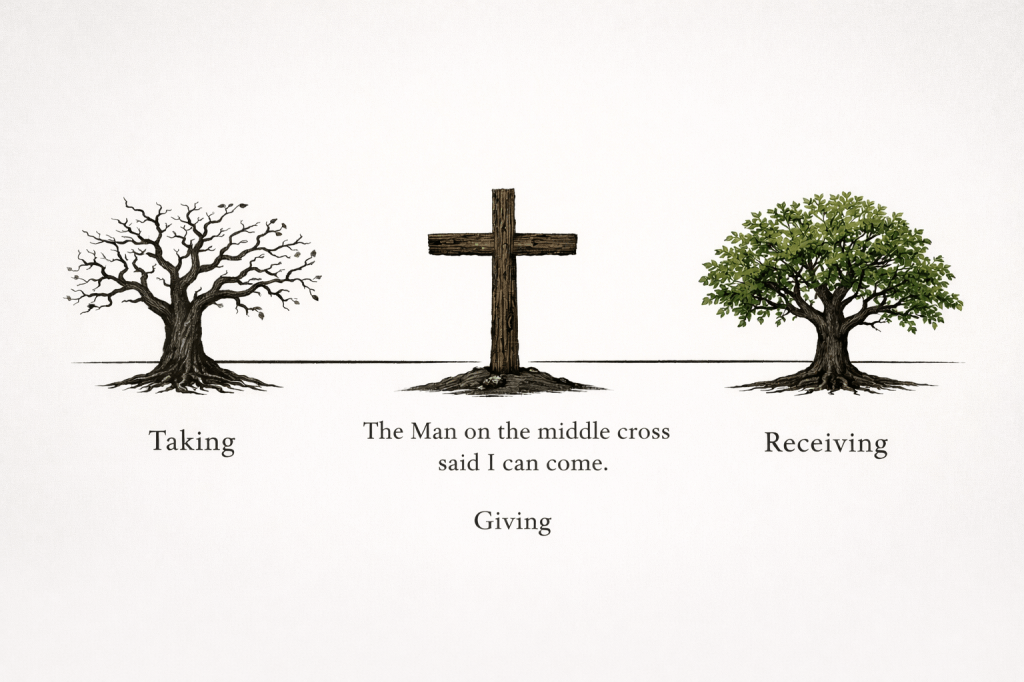
Fast forward.
The story doesn’t stay in a garden.
It moves to a hill.
And there, almost deliberately, stands another tree.
Not symbolic. Not distant. Real.
The Cross.
Before we move too quickly past it, we need to stay here for a moment. This is not an idea or a symbol—it is a man. Beaten, exposed, struggling for breath. Nails through wrists and feet. The One who spoke life into the world now hanging between heaven and earth – rejected by both. And still—no grasping, no retaliation, no escape. Just words of forgiveness, words of surrender, words of completion. This is not abstract theology. This is God, in Christ, choosing to give Himself fully in the place where humanity had taken. If we rush past this, we miss the centre. Because this is where everything turns—and we need to see it before we try to explain it.
Only then do we step back and realise—the New Testament even calls it that: a tree.
Not metaphorically. Directly.
Which feels less like coincidence and more like a thread being pulled tight across the whole story.
Because look at the contrast.
In Eden, humanity reaches out and takes.
At Calvary, Christ stretches out His hands and gives.
No grasping.
No taking.
No securing advantage.
Just self-giving.
As N. T. Wright puts it, the cross is not just something that happens to Jesus—it is the moment where God’s way of ruling the world is revealed. Not through force, but through self-giving love.
That flips everything.
A Conversation at the Worst Moment
No grasping.
No earning.
No spiritual résumé.
Now zoom in.
Three crosses.
Three men.
One is still grasping—angry, defensive, demanding escape.
The other does something different.
He doesn’t argue his case.
He doesn’t pretend innocence.
He doesn’t try to bargain.
He simply says:
“Lord, remember me.”
That’s it.
And Jesus answers:
“Today you will be with Me in Paradise.”
Not “eventually.”
Not “once you’ve sorted yourself out.”
Not “after review.”
Today.
And the word used—Paradise—is the same word used in the Greek Old Testament for Eden.
So in the middle of execution, in the worst moment imaginable, someone steps back into the story that was lost at the beginning.
Not by taking.
By receiving.
Which, if we’re honest, is far harder for most of us.
It reminds me of a reflection from Alistair Begg, who imagines that man arriving in heaven with no theological answers, no credentials, no explanation for how he got there. When pressed—“On what basis are you here?”—his answer is simple:
“The man on the middle cross said I can come.”
And that’s the whole thing.
Not what he had done.
Not what he understood.
Not what he could prove.
Only who he trusted—and the One who said he could come.
The Ending That Looks Familiar
By the time you reach the end of the Bible, you start to recognise the scenery.
There’s a river.
There’s life.
And there it is again.
The tree.
But this time, no guards.
No sword.
No barrier.
Just access.
“On either side of the river was the tree of life…” (Revelation 22:2, NKJV)
What was once withheld is now given.
Not because humanity improved enough.
But because something changed in the middle of the story.
So What Actually Changed?
This is where most explanations either get too technical or too vague.
So keep it simple.
In the beginning, humanity tries to become like God by taking.
In the middle, God reveals Himself by giving.
At the end, life is no longer something to grasp—but something to share in.
That’s the shift.
As Irenaeus argued, the story of Scripture is not just about recovering what was lost, but about being brought into something fuller—matured, restored, completed.
Not back to the start.
Forward to fulfilment.
Easter, Without the Cliché
Easter is often reduced to forgiveness.
And it is that.
But it’s more.
It’s access.
It’s the reopening of something that was never destroyed—only held back until it could be given properly.
Not taken.
Given.
The way back to life isn’t found by trying harder to reach it.
It’s found by recognising the One who already has.
And If You Strip It Right Back
The whole story can be held in three movements:
We took.
He gave.
Now we receive.
And the only question left is whether we still try to take—or finally learn to receive.
That’s it.
And that’s why Easter doesn’t just answer what went wrong.
It shows us how to come home.
Reading On
If this resonated with you, you might want to take a little time to sit with it.
Not to analyse it.
Not to overthink it.
Just to consider what it means to stop grasping—and start receiving.
If you’d like to explore this further, you might find these reflections helpful:
Each approaches the same theme from a different angle—learning to live without constantly reaching, striving, or proving.
And if you’d like to go deeper into my wider work, you can find my published writing here:
https://www.amazon.co.uk/stores/Stuart-Patterson/author/B07RM6KKBN


 Window Seat
Leave a comment