
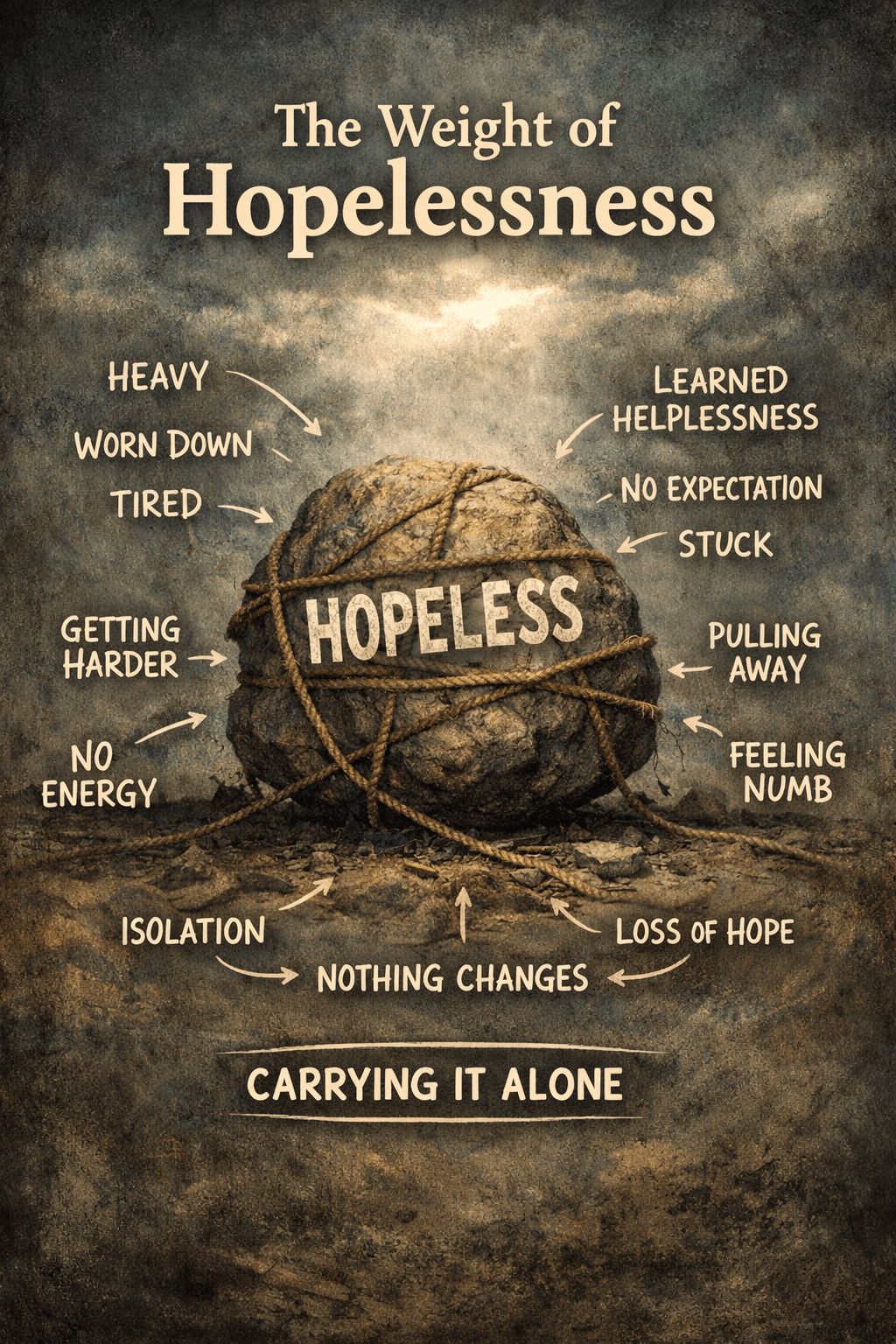
There’s a kind of weight that doesn’t show on the outside.
You can still get up, go to work, and hold a conversation. From a distance, everything can look more or less the same.
But underneath, something feels heavier than it should. It’s rarely dramatic, and it’s not usually loud. It just sits there, quietly, affecting how everything else feels.
Simple things take more effort. Getting started takes longer. Even things you used to enjoy don’t quite land the same way.
And it’s not always clear why.
Sometimes there isn’t a single moment you can point to. No obvious cause. Just a slow sense that something has settled in.
That’s often what hopelessness feels like. It isn’t always despair. More often, it’s the quiet absence of expectation.
You stop looking forward to things.
You stop expecting change.
You begin to assume that things will stay much the same.
And once that settles in, it starts to shape how you see everything else. Opportunities feel distant. Progress feels unlikely. Even small steps can feel pointless.
Psychologists sometimes describe this as learned helplessness — when repeated experiences, especially those that felt out of our control, begin to teach us that effort doesn’t change outcomes.
Over time, that learning doesn’t stay in one area. It spreads. Often without us even noticing, it becomes a general way of seeing the world.
And that’s what makes it heavy. Because it isn’t just what you feel. It’s what you begin to expect.
Scripture recognises this in its own language:
“Hope deferred makes the heart sick…” (Proverbs 13:12)
That’s not exaggeration. It’s observation. When hope is delayed or repeatedly disappointed, something internal begins to wear down. Not all at once, but gradually.
The weight then comes not only from circumstances, but from within — from what you no longer expect to change.
And that’s where the weight really sits. In what has happened, and in what you’ve stopped looking for.
And this is where Jesus speaks directly into that kind of weight.
“Come to Me, all you who labour and are heavy laden, and I will give you rest.
Take My yoke upon you and learn from Me, for I am gentle and lowly in heart, and you will find rest for your souls.
For My yoke is easy and My burden is light.” (Matthew 11:28–30)
He doesn’t dismiss the weight. He names it.
Heavy laden.
Carrying more than you were meant to carry. Worn down, not always by one thing, but by the accumulation of many things.
And His invitation is simple.
“Come.”
Not an instruction to try harder. Not a demand to fix yourself.
An invitation to come as you are.
He then says, “Take My yoke… and learn from Me.”
A yoke doesn’t remove responsibility. It changes how the weight is carried. It means you are no longer carrying it alone.
And that matters, because hopelessness often grows in isolation. Not only in what we face, but in how long we’ve been carrying it by ourselves.
The difficulty is that this kind of weight doesn’t usually lift through pressure.
Being told to “be positive” doesn’t help. Trying to force hope rarely works.
Hope isn’t something we manufacture on demand. It is often rebuilt slowly.
Through small moments.
Through steady presence.
Through experiences that begin to interrupt what we had come to expect.
Scripture speaks about hope in that way.
Not as a feeling first, but as something rooted in God’s character.
“The Lord is my portion,” says my soul,
“Therefore I hope in Him!” (Lamentations 3:24)
Those words are written in the middle of loss, not outside it.
Hope, in that sense, is not denial. It is not pretending things are fine.
It is choosing, sometimes very quietly, not to let present weight have the final word.
That choice can begin very small.
It rarely arrives as a big shift or a sudden breakthrough. More often, it begins with something like:
“Maybe this isn’t the end of the story.”
That’s often where it starts.
Because the opposite of hopelessness isn’t always certainty.
Sometimes it’s simply the return of possibility.
And possibility is lighter.
Even if only slightly.
Even if only at first.
If this feels familiar, it may simply be a reminder: The weight you feel is real. But it isn’t the whole story.
And even where hope feels thin, it can be rebuilt — slowly, steadily, and often in ways you don’t immediately notice.
A quiet note
If you’re carrying something that feels heavy or unchanging, it can help to speak to someone. Professional support, therapy, or simply being heard by someone you trust can begin to ease that weight.
If you need to speak to someone now, Samaritans are available in the UK 24 hours a day on 116 123, or at www.samaritans.org.
If this helps…
You may want to read:
Not Every Trigger Is a Threat
Not Every Struggle Is a Relapse
Why We Go Back
More Than the Wound
Books
For more from me, including my published work on my Amazon page.

 Window Seat
Leave a comment